“I Thought It Was Too Good to Be True”: Oliver Howells on Real Slow Motion in a Home Studio

Pixboom
·2026-10-16
Oliver Howells is a tabletop videographer and social media content creator based on the Isle of Wight, the small island off the bottom of the UK. For the last five or six years he’s specialised in making content for brands and products.
He wanted a slow motion camera for a long time before he had one. When he first read about the Pixboom Spark online, his reaction was the one most working filmmakers had.
“This is too good to be true. I wanted a slow motion camera for such a long time, and when I saw it was a Kickstarter I thought, no, there’s no way this is going to be what it is.”
This is what happened after that — in his words, from a home studio he describes as no bigger than a bedroom, and from a monster truck event on his island.
The Compromise Everyone Makes
Before Spark, Oliver did what he reckons most people do when they want slow motion: shoot at 120fps and stretch it in the edit.
“I think I’m probably the same as most people. When you want to do something in slow motion, you automatically think, I’m shooting at 120fps. That’s my max, probably, for the camera. And then in post-production you try to slow it down as much as you possibly can without it looking weird and warpy.”
He knew what it cost him. Shooting that kind of content on his normal camera meant pushing it to the absolute limit, and it still probably wouldn’t look the way he fully wanted it to.
He’s blunt about what 120fps actually gets you.
“You are gaining some sort of slow motion. But the way that I describe it isn’t true slow motion. You’re gaining slower, slower motion, but it’s still most of the time what the eye can see.”
What he wanted to capture was the part we miss — the split seconds that never make it to the eye at all.
The Camera He Didn’t Believe In
He’d seen Spark on social media in 2025 and didn’t believe it. When he heard Pixboom would be at IBC in Amsterdam — a show he wasn’t attending — he asked every friend who was going to track the team down and get him a contact. Ten days after the show, Pixboom’s CMO messaged him: they wanted to send him a beta camera, and he’d be one of the first people in the UK to shoot on it.
Asked when it clicked, he points to the first time he switched it on.
“At the time of testing out the beta camera, I knew that as soon as I watched and played back that footage and saw legitimate slow motion happening, I knew that there was endless potential for where this could lead to.”
He filmed that early testing and put it on his own channel — shot on the pre-production beta unit, before the camera shipped.
What Actually Changed
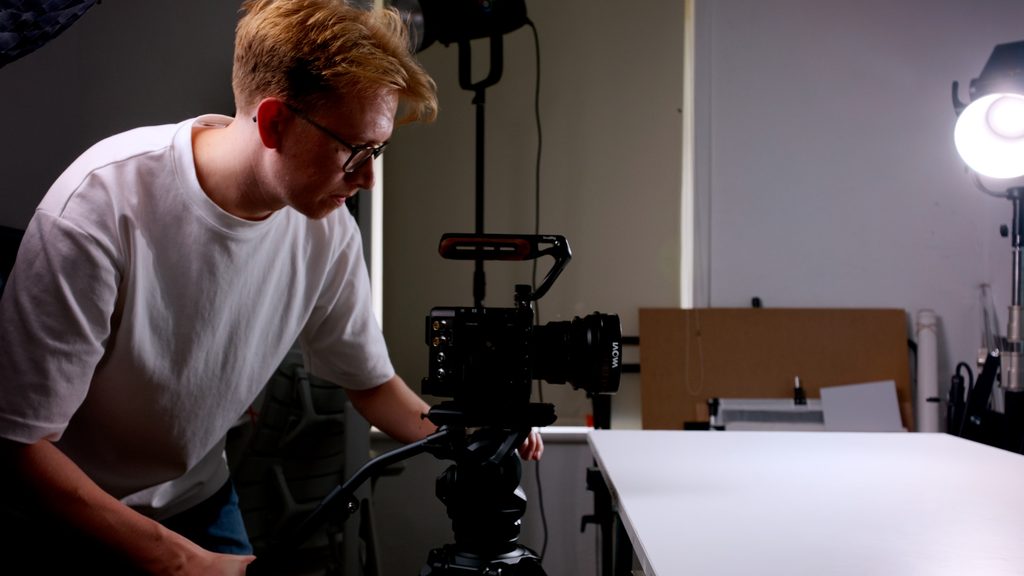
1. Three lights, in a room the size of a bedroom
What surprised him, coming from the slow motion cameras he’d used before, was how little light this one needs.
“I knew that previously I was trying to rig up as many lights as possible just to get this thing to look okay, or even show any kind of image. But with the Spark, you can find a nice balance with it.”
His setup now runs on three or four lights, max. Three gets him comfortably to around 600fps; adding one more — a big one — takes him to 1000fps.
He shoots it at ISO 400, 180-degree shutter angle, open gate. Open gate matters to him for a second reason: it’s the format he wants for social, because it converts cleanly from landscape to portrait.
Most of his lights are 600W. The two that really save him are his higher-output heads — with just those two set up, he says, he can create content, bouncing the light around and manipulating it rather than adding more heads.
“Usually you’re trying to force light into the camera and you’d be bumping up that ISO. But to shoot at a much lower ISO is incredible.”
The practical consequence has nothing to do with image quality. His home studio is no bigger than a bedroom.
“Automatically, that means that I have more space. I’m not scrambling over twenty tripods around to the back of the set. I’m just working and naturally flowing around that space.”
2. It behaves like a normal camera
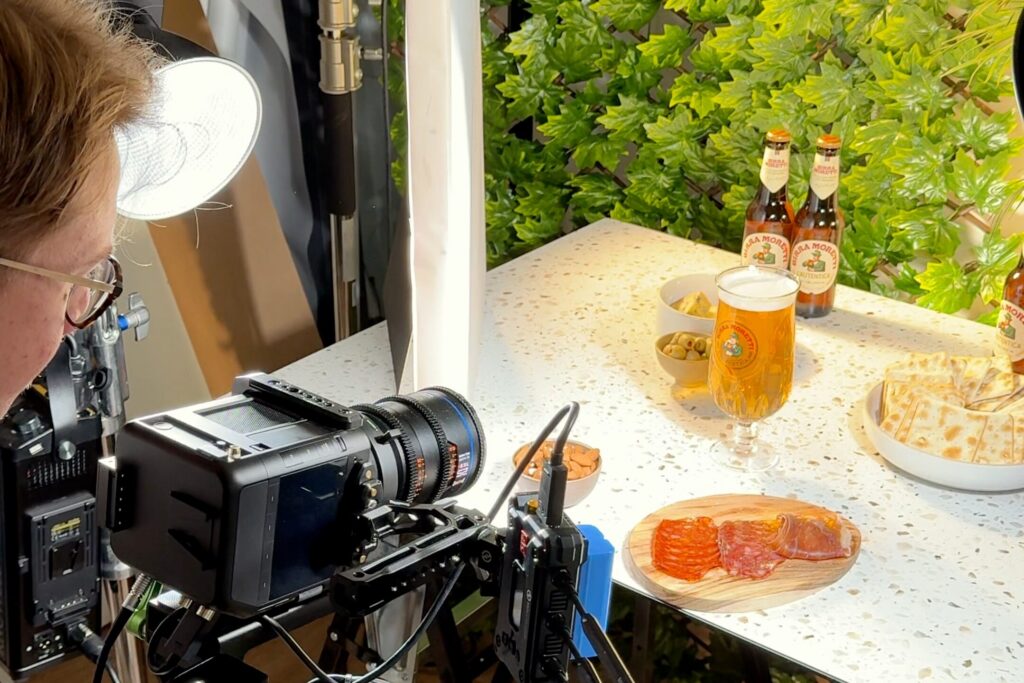
The weight is the part he admits might sound odd to care about — but it means he doesn’t need many tools to hang it for a top-down shot, even with a couple of heavy lenses on it. It looks big and boxy; he says it’s actually very lightweight and compact.
Building the rig is easier for the same kind of reason. The connections are the ones he’d expect on any normal camera — HDMI, an SD card, the big SSD — and there are screw mounts all over it for a cage and a monitor.
“It doesn’t feel like a long process. It just feels like you switch out what you want to and build it and adapt it to that kind of shoot that you have in mind.”
None of that is a headline feature. It’s the difference between a camera you have to build a shoot around, and one that joins the kit you already own.
3. Hit record, go again
Liquid is the difficult one — free-flowing, so you don’t know what it will do unless you repeat the motion over and over. His process starts with the rig, not the camera.
One he singles out as a really fun build: drilling into the back of a bottle, fitting a tube through it, and blowing liquid up and out of the top with the cap flipping off.
Iterating like that depends on how quickly you can go round again. On his previous cameras, he says, that felt like a complicated process — boot the camera up, shut it down, grab the footage, offload it, wait through the buffer period.
“It gives that run-and-gun mentality with it. Even though I’ve got everything rigged up, as soon as you’re ready for that shot, boom, you hit record, you get the shot, you play it back, whether you got it or not, take out that SSD, put it on a drive, done. It’s that simple.”
His point isn’t really about storage. It’s about where his attention goes.
“For a lot of people, that’s what they need as a creative. You don’t really want to be thinking about the kit. You want to be thinking about the creative aspect of the shoot that you’re trying to capture, the whole vision. And it creates a free flowing work form.”
Back in the studio, he used the same word about moving around the set. Fewer lights let him flow around the set; recording straight to SSD lets him flow through the takes. Different constraints, same result — the kit stopped interrupting him.
Turning It Into Client Work
The first thing he did with it was go and sell it in — and everything that follows was shot on that same pre-production unit. It had arrived at the end of the year, so he used the quiet run into Christmas deliberately: time on the camera, so it was ready when the next project landed.
“I would talk to my clients and be like, look, I’ve got this new bit of equipment, we can capture this now. Do you want to have a go and see if we can create something cool for a new social media campaign?”
Then a message came in from Birra Moretti. The campaign goal was to show off a new glass they were launching, and his first reaction was the honest one.
“Initially I thought … it’s a glass, how this is going to be difficult. How can we make that look good?”
The answer was slow motion. Slowed down far enough, the pour stopped being a pour: light refractions moving around the glass as the liquid poured in, air bubbles popping, macro detail — things you wouldn’t typically see in real time. The brand also wanted the feeling of that first cheers with friends, the first drink poured. Being able to show that through the camera, he says, really stepped up his content compared to shooting on his normal camera.
“The liquid curves and warps and reshapes around the glass. You want to be able to capture those moments of light refracting in different ways and shifting and changing. It’s a different art form. It’s the beauty in what we miss in those seconds.”
There’s a commercial edge to it, too.
“I think it really helps showcase a different level of professionalism, especially in my work, and produces something that the brand possibly hasn’t seen before.”
What he’s building toward:
“I want to be able to build that portfolio where brands go, how does this guy do this? How did he manage to create that moment?”
Client feedback, he says, has been continuously positive — that this is absolutely what they were looking for. What they tell him they can see is the effort.
“It’s not just I’m pressing record and everything’s all set up in front of me, it’s the time it takes to actually build those sets and rigs and be able to understand what is visually going to be the best shot for the client.”
There’s a practical reason a high-speed deliverable goes so far. Record a slow motion take and you’re watching potentially five to ten seconds of footage unfold — a lot of usable moments out of one build.
Taking a Studio Camera Outdoors
Other creatives have started asking him about the camera, including a friend who works with Aston Martin — a use case at the opposite end of the spectrum from tabletop.
“You’re out there running and gunning with cars that are going very fast. There’s a lot happening in those split seconds of moments — you want to be able to have a reliable camera that’s there ready to capture each shot, you just flick it on, press record, get that moment, stop.”
He’d been feeling the same pull himself.
“I knew that as soon as this was in flow, I love this, I wouldn’t stop at all. And it just makes you want to go out and try something else, whether it’s inside or outside.”
Then he called Jose Venezolayan (@venezolion) and said there was a monster truck event on his island — was it worth doing? Jose’s answer was yes.
For a studio shooter, this is the uncomfortable version of the job. No home studio, no repeatable rig, nothing under his control.
“There was a lot of nervous energy from me. I was trying to find my comfort. It’s like everything’s exposed to me.”
He describes trying to understand how to get a really good detailed shot in a split moment — and then it’s gone. “As soon as it’s done, it’s done.”
He put a massive 300mm lens on it and shot the detail of shards flicking everywhere. What made it workable, he says, was being able to record from different positions and to test and practise things quickly and freely — where normally he’d need a lot more time to digest the situation and tell everyone to wait a second before rolling.
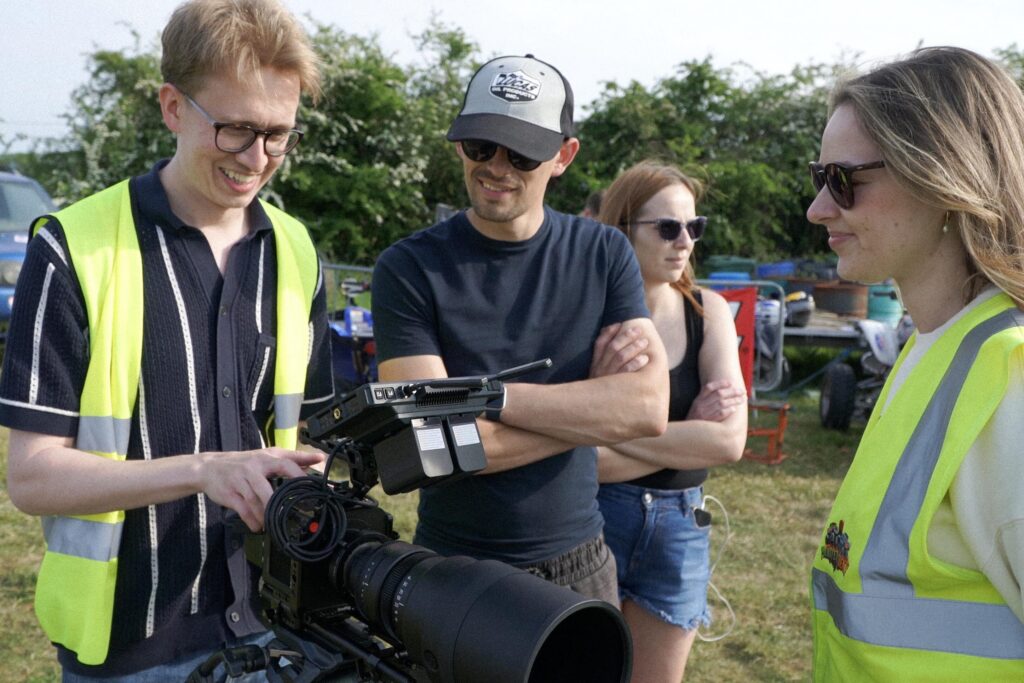
He keeps coming back to one moment from that day.
“We went and showed the guys the monster truck footage, they were like, wow, we’ve never seen anything like this.”
His takeaway from the day wasn’t about the camera at all.
“There’s actually amazing growth in seeking discomfort. You want to be able to push yourself to the limits as well as you want to push your camera to the limits.”
And later, on watching it back:
“Looking back on it and watching those clips back, you think, well, I wouldn’t have got that unless I tried.”
He knows how water and materials behave inside his studio. What he wants now is to test the camera in more extreme environments — dirt bikes flicking up mud, people surfing across water, real-time moments captured and played back.
Part of the appeal, for him, is that it’s a shared experience.
“When you work alongside other people that are passionate about what they do and they get to see those moments back, I think it’s actually quite special. And that’s what I think makes me want to go out and try that bit more.”
Is This You?
Oliver’s story is worth reading for what it isn’t as much as what it is. He isn’t a Phantom owner trading down — the Phantom, in his words, is a great camera, but crazy money, there aren’t many out there, and it isn’t accessible to everyone anyway. He’s a tabletop shooter who used to push 120fps as far as it would go, and who now shoots the thing he used to approximate.
“For Pixboom to really build a camera that is probably made more for content creators, tipping into that professionalism, is like opening a brand new door. And I just knew that when I picked it up, it clicked 100%.”
If you shoot product, liquid or tabletop work where slow motion is the brief rather than the bonus — this is your story. If you’ve been slowing 120fps footage in post and quietly knowing it doesn’t hold up — this is your story. If you work out of a small space and assumed high-speed meant a lighting truck, he reckons three lights get him to around 600fps in a room no bigger than a bedroom.
And if you’ve decided you’re a studio shooter and that’s that — he thought so too, right up until the monster truck.
If you shoot motion control rather than tabletop, there’s a second owner story worth reading — [Backer #54: how a UK motion-control studio put Spark on a robot arm].
The Beauty in What We Miss
What Oliver describes isn’t really a spec upgrade. It’s the end of a compromise he always knew he was making — he could see his camera being pushed to its absolute limit, and he knew the result probably wouldn’t look the way he wanted. He just didn’t have a way around it.
The camera didn’t give him better ideas. He already had those. It gave him a way to shoot them, in the room he already had, fast enough to try something and find out.
“It almost felt like it was meant to be. The goal for me was to really have a better understanding of slow motion, and for Pixboom to almost coincidentally build that camera and me go, yeah, that’s perfect timing for me.”
See what 4K at 1000fps actually looks like → [watch Spark sample footage]. Want the full picture? [Check Pixboom Spark].


